
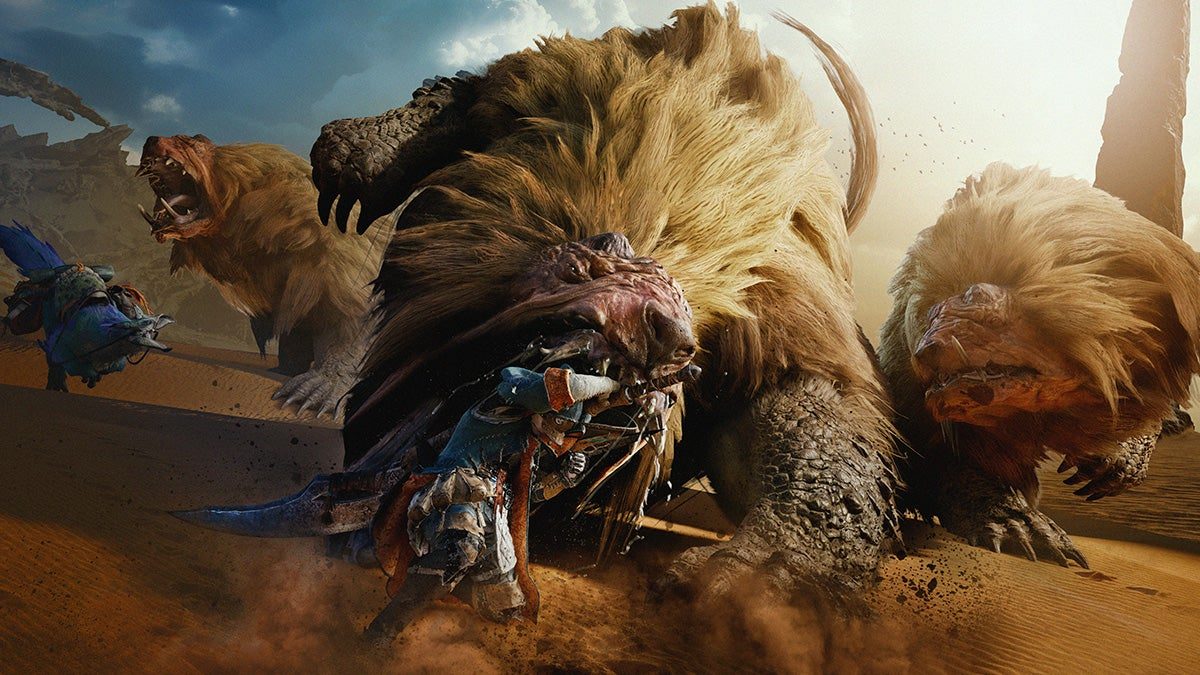
I have tried going back to Monster Hunter Wilds several times.
That feels important to say because I did not judge the game at launch and then refuse to reconsider it. I returned after the updates. I looked at the new monsters, the expanded endgame, and the new rewards. I gave Wilds more chances because I wanted it to become a Monster Hunter game I could love for years.
Omega Planetes arrived with Title Update 3. Gogmazios followed in Title Update 4. These should be exactly the kinds of fights that pull me back.
But I do not feel like clearing Omega Savage.
I do not feel like clearing Gogmazios.
It is not because I am afraid of difficult hunts. Some of my favorite memories in this series come from failing repeatedly, learning a monster, changing my equipment, and finally earning the clear.
The problem is simpler.
I do not care about the progression surrounding these fights.
Wilds keeps giving me more things to fight, but it has not restored my reason to hunt.
This Is Not Just My Personal Burnout
Community sentiment around Wilds is divided, and the numbers show it.
According to the current Steam customer-review breakdown, 199,417 verified purchaser reviews give Wilds an overall rating of Mixed. When reviews from every purchase source are included, the split is almost perfectly even: 160,992 positive reviews against 167,189 negative ones.
The regional divide is just as revealing. English reviews are Mostly Positive, while Simplified Chinese and Japanese reviews are Mostly Negative. Recent reviews across all languages remain Mixed.
There is no single community verdict on Wilds.
There are players who love it, players who cannot run it properly, players waiting for the expansion, and players like me who keep returning but cannot find a reason to stay.
Even Capcom has acknowledged the disconnect. Wilds sold 10 million copies during its first month, but Capcom later reported that its first-quarter sales fell short of the company's expectations. Capcom said it would work to improve user satisfaction through updates after receiving extensive feedback.
This does not mean Wilds is a failure. It means the launch audience and the long-term audience are not the same thing.
My own MH Tracker data shows the same tension from another direction. Wilds still accounts for roughly 59 percent of the Monster Hunter streaming hours we tracked. It remains the largest active game in the series on Twitch.
However, the activity after Title Update 4 followed a spike and then settled into a plateau. People are still playing, but this is not launch momentum anymore. It is a stable niche waiting to see what comes next.
Wilds is active.
Wilds is popular.
Wilds is also deeply divisive.
All three things can be true.
Omega Savage Is Difficult, but Difficulty Is Not Motivation
Omega Planetes arrived as part of the Final Fantasy XIV collaboration in Title Update 3 and produced exactly the reaction you would expect from a major difficulty spike.
Some players celebrated it as the first fight in Wilds that truly demanded teamwork. Others hated its mechanics, its sudden jump in difficulty, or the experience of repeatedly failing with random groups.
The community response ranged from players calling it one of the best fights in the game to players saying it was miserable without support hunters.
That division is not surprising. Difficult fights have always divided Monster Hunter players.
What matters to me is that I feel no desire to enter the argument.
I do not look at Omega Savage and think, "I need to beat that."
The normal and Savage versions offer Final Fantasy XIV collaboration rewards, including Omega equipment. Those rewards may be exciting for players invested in the crossover, but they do not repair Wilds' wider progression.
Omega remains a collaboration encounter sitting beside the main Monster Hunter roster rather than strengthening the relationship between the roster and the equipment system.
A difficult fight is not automatically a meaningful fight.
I need a reason to care about the victory beyond proving that I completed it. I need the hunt to connect to a larger journey through the game.
Omega Savage may be a good challenge.
I simply do not want it.
That difference matters.
Gogmazios Should Have Brought Me Back
Gogmazios should be different.
This is not a crossover monster. It is one of the most memorable Elder Dragons from Monster Hunter 4 Ultimate. Its return should have been enough to get me preparing equipment, calling friends, and planning an entire evening around the hunt.
Capcom clearly positioned Gogmazios as a major endgame destination. The encounter requires Hunter Rank 100 and uses a special formation with up to four player hunters and four support hunters. Defeating it unlocks a repeatable quest for farming its materials.
Those materials upgrade Rarity 8 Artian weapons into Gogma Artian weapons. More importantly, Capcom's official explanation confirms that every Gogma Artian weapon receives a randomly selected Set Bonus Skill and Group Skill.
The flagship reward for hunting Gogmazios is another layer of randomized weapon progression.
This is exactly what I do not want.
The frustration is not difficult to find. In one detailed discussion about the Gogmazios and 10-star endgame, a new Monster Hunter player described spending 20 to 25 minutes on Gogmazios, sometimes failing, only to receive another chance at skills or bonuses they might not want.
The player wanted to hunt the rest of the roster but felt pushed back toward Gogmazios to complete several weapons. Other hunters responded that they had stopped engaging with the randomized endgame entirely or simply accepted whatever rolls they received.
That does not prove every player hates the system. Some people enjoy long optimization grinds. Some want a nearly endless reason to keep improving their equipment.
It does show that my reaction is not isolated.
The Casino Has Swallowed the Endgame
Randomness has always been part of Monster Hunter.
Monster parts have drop rates. Charms have been randomized. World randomized decorations. Rise returned to randomized talismans. Other games experimented with relic weapons, investigations, augments, and different forms of long-term grinding.
I am not asking for every reward to be guaranteed.
The problem is not that Wilds contains RNG. The problem is how many important progression systems lead back to it.
Wilds introduced Artian weapons as an endgame weapon system. It later added high-difficulty quests that reward stones appraised into talismans with randomized skills. Gogmazios then added another endpoint for Artian weapons with randomly selected bonus skills.
The loop increasingly looks like this:
- Hunt difficult monsters for a chance at the correct talisman.
- Hunt tempered monsters for Artian weapon materials.
- Upgrade Artian weapons and hope for useful reinforcement results.
- Hunt Gogmazios repeatedly.
- Upgrade those weapons again.
- Hope the randomly selected skills fit the build.
- Repeat the process for other elements and weapon types.
This is not one controlled layer of RNG.
It is a stack of lotteries.
The game is no longer asking which monster's weapon I want to craft. It is asking how many times I am willing to pull the handle.
That changes Monster Hunter from a crafting game with random drops into a casino with crafting menus.
The Casino Also Shrinks the Roster
The greatest cost is not the time spent grinding.
It is what happens to every monster outside the grind.
Monster Hunter Wilds contains a roster of creatures with unique materials, armor, visual identities, elemental properties, and weapon designs. Each monster should represent a different possible project.
Maybe I need one monster for a fire weapon. Another has the armor skill I want. A third has a strange weapon that is not mathematically perfect but gives me a new way to play.
That variety creates momentum.
One project leads to another. The weapon I craft helps me fight the next monster. That monster unlocks another piece of equipment. Eventually, an entire evening disappears because the equipment tree naturally carried me across the roster.
That is the kind of grind I enjoy.
I do not mind repeating hunts when I am working toward something specific. I can see the weapon I want. I know which monster parts I need. Every successful hunt moves me closer to a clear goal.
Wilds' casino endgame compresses those possibilities into a small set of efficient activities.
Community discussions about the current weapon balance repeatedly make the same distinction: ordinary monster weapons remain usable, but Gogma Artian weapons are usually the optimal choice.
In one discussion comparing crafted monster weapons with Gogma Artian weapons, players reported that even imperfect Gogma Artian weapons could outperform crafted alternatives, particularly for elemental builds. One player summarized the situation bluntly: monster weapons were viable, but not optimal.
"Viable" is not the same as meaningful.
Yes, I can choose to use weaker equipment. I can deliberately ignore the endgame. I can invent personal restrictions to make the roster relevant again.
But I should not have to protect Monster Hunter from its own reward structure.
The game should give me reasons to hunt its monsters.
Weapons Have Become Cosmetic Receipts
This may be the part that disappoints me most.
Monster Hunter weapons used to feel like trophies.
You defeated a monster, carved its materials, and transformed those materials into something carrying its identity. The shape, colors, sounds, elemental properties, and weaknesses of the weapon connected it directly to the creature you had learned to hunt.
You did not simply receive an upgrade.
You earned the right to carry a piece of that monster into the next battle.
Now I often look at a monster weapon and think about crafting it only to unlock its layered appearance.
That is one of the biggest downfalls of modern Monster Hunter.
The weapon itself is no longer the reward.
Its skin is.
The real equipment underneath becomes an optimized collection of statistics from the endgame system. The crafted monster weapon becomes a cosmetic shell placed over the weapon the numbers tell you to use.
Layered weapons are not bad by themselves. Players should be able to control how their hunters look. I have no problem with fashion hunting.
The problem begins when appearance is the only meaningful reason to craft much of the weapon tree.
A beautifully designed weapon should not exist primarily as a cosmetic unlock.
It should make me consider another build. It should create a new matchup. It should send me back to the monster that produced it. It should be something I want to use, not something I craft and immediately place over another weapon.
When the best use of a monster weapon is hiding a casino weapon, the relationship between hunting and crafting has broken.
Modern Multiplayer Scaling Changes Why I Hunt With Friends
The same loss of purpose appears in multiplayer.
Before World, gathering hall quests generally used fixed monster health. A monster did not gain more health when another hunter joined.
For example, community-documented Monster Hunter Generations values place High Rank Deviljho at roughly 6,600 health in Village and roughly 8,800 health in the online hub.
The important part is not the exact number.
The hub version kept the same health whether one hunter entered or four.
The hub monster was already stronger because it was designed for multiplayer. If I attempted it alone, I accepted the full hub health pool. If a friend joined, the monster did not receive another health increase.
My friend was pure additional power.
We played together because two hunters could clear the same quest faster than one. Three could make it faster still. A fourth hunter could turn a difficult farming session into a relaxed evening.
The incentive was simple: bring friends and hunt more efficiently.
World changed this relationship by dynamically scaling monsters according to party size. Base World initially used solo and multiplayer settings, which could make two-player hunting particularly inefficient because a duo could receive health intended for a larger group. Iceborne improved the system by adding dedicated two-player scaling.
Wilds continues with dynamic party scaling. Community testing generally places its approximate health multipliers around:
- One player: 1.00 times health
- Two players: 1.63 times health
- Three players: about 2.00 times health
- Four players: about 2.34 times health
Capcom has not published a universal scaling table for every Wilds quest, so these should be treated as community-tested approximations rather than official constants.
The scaling is sublinear. A coordinated group can still finish a hunt faster. Four competent hunters should comfortably outperform a monster with 2.34 times its solo health.
The problem becomes clearest with two players.
When a friend joins my solo hunt, the monster gains roughly 63 percent more health. That friend must contribute more than 63 percent of my effective damage just to make the hunt faster than my solo run.
If they are learning a new weapon, undergeared, getting hit frequently, or simply playing casually, the hunt can take longer.
Before World, the hub monster already had its fixed health. Any damage my friend contributed helped shorten the hunt.
In Wilds, their first job is paying off the health added because they joined.
This does not make multiplayer mathematically useless. Strong groups still gain an advantage. Multiple hunters can divide the monster's attention, create more openings, apply status effects, and combine support skills.
But the feeling has changed.
I used to invite friends because more hunters meant faster farming against the same target. Now I sometimes invite friends while knowing the game will inflate the target to compensate for their presence.
The system tries to preserve difficulty. In doing so, it weakens one of the most natural incentives for cooperation.
I do not need every multiplayer hunt to become a speedrun.
I just miss the honesty of the old arrangement.
The quest was built for the hall. The monster had its health. Bring whoever you wanted, and every additional hunter helped.
More Fights Cannot Fix Meaningless Progression
This is why Omega Savage and Gogmazios have not brought me back.
The issue is not whether the fights are mechanically good.
Omega may be one of the hardest fights in Wilds. Gogmazios may be visually spectacular. Both can be excellent encounters while still failing to repair the game around them.
A new monster enters a progression system that already feels empty to me.
I could learn the fight. I could clear it. I could collect the materials. I could roll another weapon.
Then what?
Do I return to the same casino?
Do I keep rolling for slightly better equipment?
Do I craft another monster weapon mainly to unlock its layered appearance?
Do I ask a friend to join while knowing that the game will increase the monster's health to compensate?
More content cannot solve a broken reason for engaging with that content.
I Do Not Hate Wilds
The strange part is that I do not hate Monster Hunter Wilds.
Hate would require more energy than I have left for it.
I have criticized the launch roster, the lack of direction, the difficulty, the progression systems, and the loss of the hunting experience. I kept hoping that the updates would assemble those unfinished pieces into a game I wanted to play for hundreds or thousands of hours.
I tried returning more than once.
Each time, the result was the same.
I opened the game, looked at the available hunts, thought about the progression waiting behind them, and lost the desire to continue.
That feeling is worse than anger.
I can argue with a game that frustrates me. I can adapt to a system I dislike. I can spend hours learning a monster that destroys me.
What I cannot manufacture is the desire to care.
Give Me a Reason to Hunt
I do not need every hunt to produce the strongest possible weapon.
I do not need every reward to be guaranteed.
I do not need Monster Hunter to become easier, faster, or more convenient.
I need the monster I just defeated to matter.
I want to look through the roster and imagine different weapons, different builds, and different reasons to hunt. I want crafting a monster's weapon to feel like the continuation of that hunt, not an administrative step toward unlocking its appearance.
I want the endgame to send me across the roster rather than pulling everything toward the same casino.
I want inviting a friend to feel like gaining a hunting partner, not activating another health multiplier.
Most of all, I want to see a monster like Gogmazios and immediately feel that old excitement. I want to prepare my equipment, call a few hunters, and lose an evening to the fight because I cannot imagine doing anything else.
Right now, I do not feel that.
Omega Savage is there.
Gogmazios is there.
I have tried returning several times.
Monster Hunter Wilds does not lack monsters.
What it has lost, for me, is the reason to hunt them.
Comments
No comments yet. Be the first to share your thoughts!